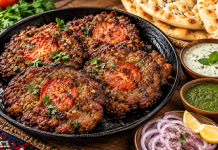

Ask a room full of rice lovers to pick between Qabili pulao and biryani, and you might start a friendly argument that lasts all evening. Both are rice-and-meat dishes served at weddings, Eid and family gatherings. Yet they come from different traditions, use different cooking methods, and taste remarkably different.Last updated: 5 October 2026
In this guide, we compare Qabili pulao vs biryani in plain words: where each comes from, how cooks make them, how they taste, how they appear around the world, and which one suits your mood.
Qabili Pulao vs Biryani: The Short Answer
Qabili pulao is an Afghan rice dish cooked in rich meat stock and topped with sweet caramelized carrots, raisins and nuts. It tastes aromatic and mild. Biryani, on the other hand, is a South Asian dish of rice layered with spicy marinated meat and steamed together. It tastes bold and often hot.
In short, choose Qabili pulao for gentle, sweet-savoury comfort, and biryani for spice and drama.
Where Each Dish Comes From
Qabili Pulao: Afghanistan’s Celebration Rice
Qabili pulao, also written Qabili palaw or Kabuli pulao, is Afghanistan’s national dish. It belongs to the wide family of pilafs cooked across Central Asia and Iran, known locally as palaw or plov. Afghan families serve it to honoured guests, and in Peshawar it has become a much-loved part of everyday eating. For more on the dish itself, see our guide to Kabuli pulao.
Biryani: South Asia’s Layered Classic
Biryani is widely linked to the royal kitchens of the Mughal era, where Persian rice traditions met South Asian spices. Over centuries, it spread across Pakistan, India and Bangladesh, and every region developed its own style. Today, biryani is among the most popular dishes in the world.
Qabili Pulao vs Biryani Side by Side
| Qabili Pulao | Biryani | |
|---|---|---|
| Homeland | Afghanistan | South Asia (Pakistan, India, Bangladesh) |
| How rice cooks | Absorbs meat stock in one pot | Partly boiled, then layered with meat |
| Main seasoning | Cardamom, cumin, black pepper | A full masala blend, chillies, saffron |
| Heat level | Mild | Medium to very hot |
| Sweetness | Yes, from carrots and raisins | Rarely |
| Rice colour | Even golden brown | White and coloured grains mixed |
| Signature topping | Carrots, raisins, almonds or pistachios | Fried onions, mint, coriander |
| Typical sides | Salad, green chutney | Raita, salan, kachumber salad |
How They’re Cooked: Absorption vs Layering
The biggest difference lies in the pot.
Qabili pulao uses the absorption method. First, cooks simmer meat until tender and keep the stock. Next, they cook rice in that stock until it drinks every drop, turning golden from browned onions. Then they steam it gently on low heat. Finally, they crown it with carrots and raisins that were caramelized separately. In many Afghan homes, the meat even hides under the rice.
Biryani uses layering. Cooks partly boil rice, then layer it over marinated meat. In kacchi biryani, raw marinated meat cooks together with the rice. In pakki biryani, the meat is cooked first. Either way, the pot is sealed and steamed on low heat (dum), so the flavours mingle.
As a result, Qabili pulao tastes evenly seasoned throughout, while biryani offers bursts of flavour from layer to layer.
Flavour, Spice and Colour
Qabili pulao is all about balance. The rice tastes savoury and meaty, the carrots and raisins add sweetness, and the nuts add crunch. Because it uses little chilli, children and spice-shy guests love it.
Biryani, by contrast, is a celebration of spice. Chillies, ginger, garlic, garam masala, yogurt and often saffron or food colour create a rich, punchy plate. Some styles also add potatoes, plums or boiled eggs.
Regional Styles of Qabili Pulao and Biryani
Both dishes have many versions:
- Qabili pulao styles: classic lamb, beef or chicken versions, plus Qabili Uzbeki, a richer Afghan style. In Peshawar, restaurants often serve it on large sharing platters.
- Biryani styles: Sindhi biryani with potatoes and dried plums, spicy Karachi biryani, Hyderabadi kacchi biryani, and Kolkata biryani with potato and egg, among many others.
Meanwhile, Peshawar has its own rice cousins too, such as Bannu beef pulao, a savoury white pulao without carrots or raisins.
Qabili Pulao vs Biryani Around the World
Both dishes have travelled with Afghan and South Asian families. Here’s how you’ll meet them abroad.
United Kingdom
Biryani appears on almost every Indian and Pakistani restaurant menu. Qabili pulao, however, lives in Afghan restaurants, especially in West London areas like Southall and Hounslow.
United States
Look for Qabili pulao in Afghan communities such as Fremont, California, and Northern Virginia. Biryani is easy to find in South Asian food hubs like Chicago’s Devon Avenue and Houston.
Australia
Melbourne’s Dandenong, with its Afghan Bazaar, serves excellent Qabili pulao. For biryani, Sydney’s Harris Park is a popular South Asian food area.
Saudi Arabia
Biryani is hugely popular thanks to the large South Asian community. Saudi Arabia also has Ruz Bukhari, a carrot-and-raisin rice dish that tastes closer to Qabili pulao than to biryani, alongside local favourites like kabsa.
United Arab Emirates
Biryani is everywhere in the UAE, from food courts to family restaurants. For Qabili pulao, head to Afghan eateries in Deira, Bur Dubai and Sharjah.
Europe
Germany, especially Hamburg, has many Afghan restaurants serving Qabili pulao. Biryani is common in Indian and Pakistani restaurants across Europe, including Paris’s Little India area around Passage Brady.
Indonesia
Indonesia offers an interesting twist. In Arab-Indonesian cooking, you’ll find both nasi kebuli, a spiced rice whose name is often linked to Kabuli pulao, and nasi biryani. So, you can compare cousins of both dishes in one meal.
Looking for Qabili pulao near you abroad? Read our guide to finding Afghan Qabili pulao near me.
What to Serve With Each
With Qabili pulao: a fresh salad of onion, tomato and cucumber, green coriander chutney, and soft naan. Since the dish is mild, a tangy chutney adds a nice lift.
With biryani: cooling raita, a spicy salan, and crunchy kachumber salad. The yogurt in raita calms the heat.
Which One Should You Choose?
- Choose Qabili pulao if you prefer mild food, enjoy a sweet-savoury mix, or are feeding children and elders.
- Choose biryani if you love spice, bold flavours and a little heat.
- Choose both if you’re hosting a big family gathering. Many Peshawar dinners serve one of each, so everyone finds a favourite.
Try Qabili Pulao and Biryani in Peshawar
Peshawar is one of the best places to taste both dishes side by side. For example:
- Order Qabili pulao through our Kabuli pulao near me page
- Browse biryani in Peshawar
- Try both the Special Kabuli Pulao and Special Biryani at Almaidah Hayatabad
- Enjoy Kabuli pulao at Shinwari Restaurant University Road
You can also explore all food delivery in Peshawar and food delivery near me.
Send Qabili Pulao or Biryani to Family in Peshawar
Living in the UK, USA, Australia, Saudi Arabia, the UAE, Europe or Indonesia? You can still treat your family to their favourite. Simply WhatsApp us at +92 334 0724724 with the dish, your family’s Peshawar address and the delivery time. Our team confirms the order and price, then delivers it hot to their door.
Can’t decide? Send both, and let the family settle the debate at the table.
Messages to send with the meal:
- “Team Qabili or team biryani? Tonight, you don’t have to choose.”
- “Dinner’s on me. Save me the raisins, and the last piece of meat!”
- “Ammi, rest tonight. Let Peshawar’s best rice come to you.”
- “Settle the pulao vs biryani debate without me. I’ll call for the verdict!”
For time zones and ordering tips, see our guides for the UK, USA, Australia, Saudi Arabia, UAE, Europe and Indonesia, or read how to send KFC and food to Peshawar from abroad.
More Peshawari and Pakistani Food
Love rice dishes? You’ll enjoy these too:
- Pakistani food
- Peshawari food
- Karahi & BBQ
- Namkeen gosht and dumpukht
- Rosh
- Chapli kabab Peshawar
- Restaurants in Peshawar
Two Dishes, One Love of Rice
Qabili pulao and biryani tell two different stories, one of Afghan hospitality and one of South Asian spice. Fortunately, you don’t have to pick a side forever. Try both, share both, and enjoy the debate.
Craving one tonight in Peshawar, or want to send it to family? WhatsApp +92 334 0724724, or download the Zarrasha app.
FAQ
What is the main difference between Qabili pulao and biryani?
Qabili pulao cooks rice in meat stock until it absorbs the liquid, then tops it with carrots, raisins and nuts, so it tastes mild and slightly sweet. Biryani layers partly boiled rice with spicy marinated meat and steams them together, so it tastes bold and often hot.
Is Qabili pulao spicy?
No. Qabili pulao is mild and aromatic, seasoned mainly with cardamom, cumin and black pepper. Its sweetness comes from caramelized carrots and raisins, which makes it popular with children and people who avoid spicy food.
Is Kabuli pulao the same as Qabili pulao?
Yes. Kabuli pulao, Qabili pulao and Qabili palaw are different spellings of the same Afghan rice dish. It’s Afghanistan’s national dish and a favourite in Peshawar.
Which is healthier, Qabili pulao or biryani?
Both are rich dishes, and their healthiness depends on the amount of oil, meat and portion size. Qabili pulao uses less chilli and masala, while biryani often uses more oil and spices. Pair either with salad and enjoy moderate portions.
Where can I find Qabili pulao and biryani abroad?
Biryani appears in most Indian and Pakistani restaurants worldwide. For Qabili pulao, look for Afghan restaurants, especially in areas like West London, Fremont in California, Dandenong in Melbourne, Deira in Dubai and Hamburg in Germany.
Can I send Qabili pulao or biryani to my family in Peshawar?
Yes. From anywhere in the world, WhatsApp +92 334 0724724 with the dish, your family’s Peshawar address and the delivery time. Zarrasha confirms the order and price, then delivers it hot to their door.